
WATERWAYS Policy Brief lists development directions that help Finland strengthen the role of maritime routes as a source of sustainable wellbeing, security, and safety
The first policy brief of the WATERWAYS project suggests that Finland can strengthen the sustainable use of Baltic Sea maritime routes and respond to the challenges of a changing operating environment by developing governance in a more holistic and systemic direction, strengthening shared maritime situational awareness, and making more effective use of existing regulatory and cooperation structures. According to the brief, these factors are key to ensuring that maritime routes can support wellbeing, safety, and security of supply in the long term.
The WATERWAYS research project has published a policy brief presenting guidelines on how Finland could strengthen the role of maritime routes as a source of sustainable wellbeing, safety, and security of supply in the changing operating environment of the Baltic Sea.
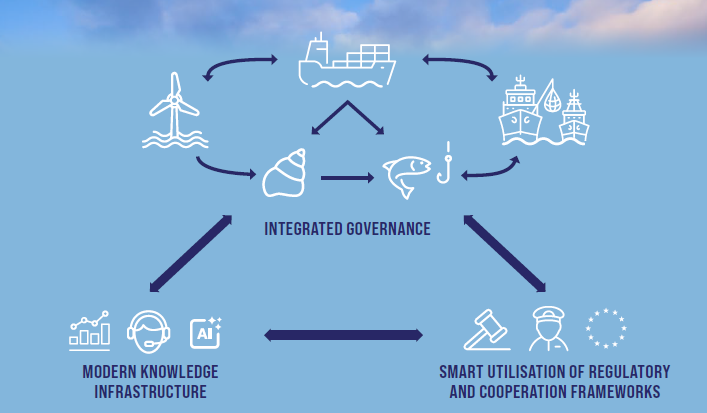
The policy brief highlights three key development directions. First, maritime routes should be examined as part of a broader maritime system in which solutions adopted in different sectors affect one another. Second, Finland should strengthen its shared maritime situational awareness by making more effective use of the latest monitoring technologies and analytical methods in the development of modern data and knowledge infrastructure. Third, existing national, European, and international regulatory and cooperation structures should be utilised more systematically in responding to the challenges of the changing operating environment.
The operating environment of the Baltic Sea is changing rapidly. Geopolitical tensions, the green transition, climate change, and increasing pressures on the use of marine areas are challenging traditional ways of planning and governing maritime transport and the use of marine areas.
More than 95 per cent of the total weight of Finland’s foreign trade cargo transport is carried by sea. However, the significance of maritime routes extends beyond trade: they are a key component of national security, security of supply, and the sustainable use of the marine environment. At the same time, factors such as the expansion of offshore wind power, changing ice conditions, and new types of security threats are transforming the operating environment in ways that require a more holistic perspective than before.
According to the researchers, examining maritime issues from the perspective of individual sectors is no longer sufficient. For example, climate, energy, safety, security, and environmental objectives may support one another, but conflicts may also arise between them, with impacts extending simultaneously across several sectors. For this reason, decision-making requires an increasingly comprehensive understanding of the dependencies, synergies, and potential trade-offs within the maritime system.
The policy brief now published presents the research consortium’s current view of the development directions to which particular attention should be paid in decision-making. It is not the end point of the WATERWAYS project’s work, but an interim step. Within the project, cooperation will continue with authorities, industry, research organisations, and other key stakeholders to identify concrete solutions. Workshops and stakeholder events will be organised around the themes highlighted in the policy brief, with the aim of identifying concrete actions for building sustainable and resilient future for Baltic Sea maritime routes.
The aim is to develop systemic future pathways based on shared knowledge and situational awareness, in which strategic policy choices, operational solutions, and the actions of different actors form a mutually reinforcing whole. A particular challenge is to identify development pathways that remain functional and viable under different future scenarios.
Link to the policy brief:
https://waterways.projectsites.aalto.fi/wp-content/uploads/sites/25/2026/10/Waterways-policy-brief_EN.pdf
About WATERWAYS:
WATERWAYS is a multidisciplinary research project funded by the Strategic Research Council (SRC) of Finland. The project produces knowledge and develops tools to support the safe and sustainable use of maritime routes in the changing operating environment of the Baltic Sea. The project examines maritime safety, environmental risks, legislation, and the cross-sectoral sustainability impacts of maritime activities. At the same time, the researchers are developing new tools for monitoring, analysis, and collaborative planning by utilising modern technologies and artificial intelligence-based solutions.
Further information on the policy brief and the WATERWAYS project:
Annukka Lehikoinen
Research Director, Kotka Maritime Research Centre (Merikotka)
Societal Interaction Coordinator, WATERWAYS Project
annukka.lehikoinen@merikotka.fi
+358 50 551 9288